Choosing the right industrial safety equipment supplier in the Philippines is an important decision for businesses that want to protect workers, support workplace safety programs, and maintain reliable operations. From construction sites and manufacturing facilities to warehouses, logistics operations, engineering projects, and industrial plants, the right safety equipment can make a significant difference in managing workplace hazards.
But finding a supplier is about more than comparing prices.
Businesses need a supplier that can provide appropriate products, dependable availability, useful technical support, accurate documentation, and reliable service. The right supplier should also understand that different workplaces have different hazards and therefore require different types of personal protective equipment (PPE) and safety solutions.
So, how do you choose the right industrial safety equipment supplier in the Philippines?
Start by evaluating product quality, suitability, standards, availability, service, delivery capability, and the supplier’s ability to support your business over the long term.
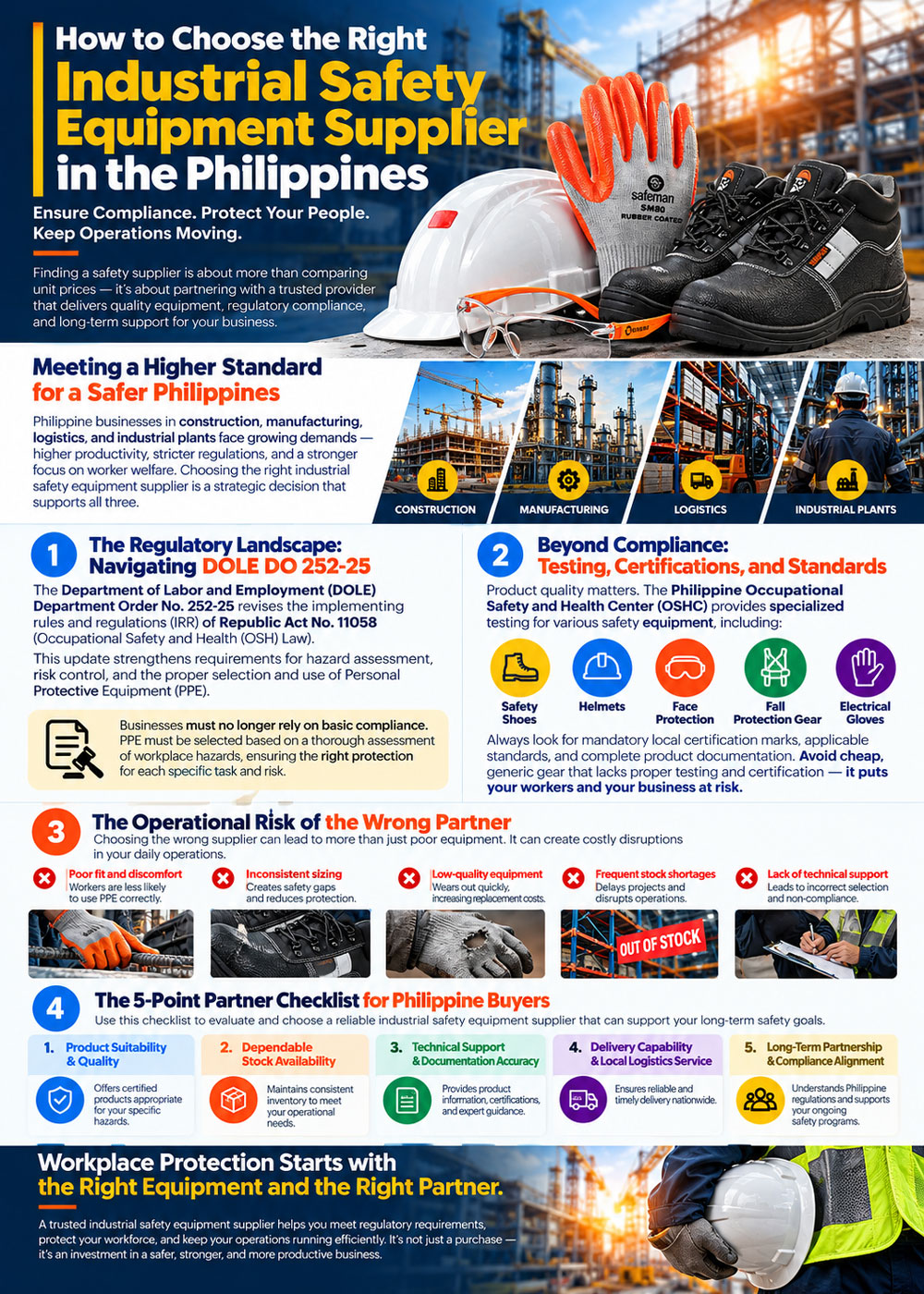
Why Choosing the Right Industrial Safety Equipment Supplier Matters
Workplace safety begins with identifying hazards and implementing appropriate controls. PPE is an important part of that safety strategy when workers may still be exposed to hazards after other controls have been considered.
For Philippine businesses, this makes supplier selection particularly important. A supplier is not simply a source of safety products. It can become a long-term partner responsible for helping businesses obtain the equipment workers need for their specific tasks and environments.
Philippine occupational safety and health requirements continue to evolve. The Department of Labor and Employment issued Department Order No. 252-25, which revised the implementing rules and regulations of Republic Act No. 11058 concerning occupational safety and health standards.
For businesses, this reinforces the importance of taking workplace safety seriously and selecting equipment based on actual hazards, appropriate specifications, and applicable requirements.
Workplace protection starts with the right equipment.
Safety equipment should be appropriate for the hazards workers may encounter.
A construction worker, laboratory employee, warehouse operator, welder, maintenance technician, and chemical-plant worker may all require very different forms of protection.
Selecting PPE simply because it is inexpensive or commonly used may not provide adequate protection.
Compliance is only one part of the equation.
Businesses should examine product specifications, applicable standards, testing information, and supporting documentation when evaluating safety equipment.
The Philippine Occupational Safety and Health Center provides PPE testing services covering products such as safety shoes, safety helmets, eye and face protection, fall-protection equipment, and electrical gloves.
Where applicable, businesses should also understand Philippine product certification requirements and look for appropriate certification marks or documentation for products covered by mandatory certification schemes.
Poor equipment choices can become an operational problem
The wrong equipment can create more than a safety concern.
Poor fit, inadequate protection, uncomfortable PPE, unreliable products, inconsistent sizing, and product shortages can affect worker acceptance and business operations.
That is why the supplier you choose matters just as much as the individual products you purchase.
What Industrial Safety Equipment Do Philippine Businesses Need?
The right safety equipment depends on the workplace, tasks, hazards, and risk assessment. Common categories include:
Head Protection
Safety helmets and hard hats can help protect workers from specific risks associated with falling objects, impact, and other workplace hazards.
The appropriate helmet should be selected according to the work environment and required protection.
Eye and Face Protection
Safety glasses, goggles, face shields, and specialized eye protection may be necessary where workers face risks from particles, chemicals, splashes, sparks, radiation, or other hazards.
Hand Protection
Gloves should be selected according to the task rather than simply choosing a general-purpose product.
Depending on the application, businesses may require cut-resistant, chemical-resistant, impact-resistant, heat-resistant, or general-purpose gloves.
Foot Protection
Safety shoes and boots can provide protection against hazards such as impact, compression, punctures, slips, electrical risks, and other workplace conditions.
The appropriate specification depends on the environment and hazards involved.
Respiratory Protection
Some workplaces may expose employees to dust, fumes, vapors, gases, or other airborne contaminants.
Respiratory protection should be selected according to the specific hazard and workplace conditions rather than using a one-size-fits-all approach.
Hearing Protection
Earplugs and earmuffs can help reduce exposure to excessive workplace noise when appropriate controls do not sufficiently reduce the risk.
Fall Protection
Workers performing tasks at height may require specialized fall-protection equipment, such as harnesses, lanyards, lifelines, and related systems.
Fall-protection equipment must be selected and used appropriately because incorrect equipment or improper use can create serious risks.
High-Visibility and Protective Workwear
High-visibility vests, coveralls, protective clothing, and other workwear may be appropriate for construction, road work, logistics, manufacturing, and other industrial environments.
Emergency and Workplace Safety Equipment
Businesses may also need first-aid supplies, safety signs, spill-control products, emergency equipment, and other workplace safety products.
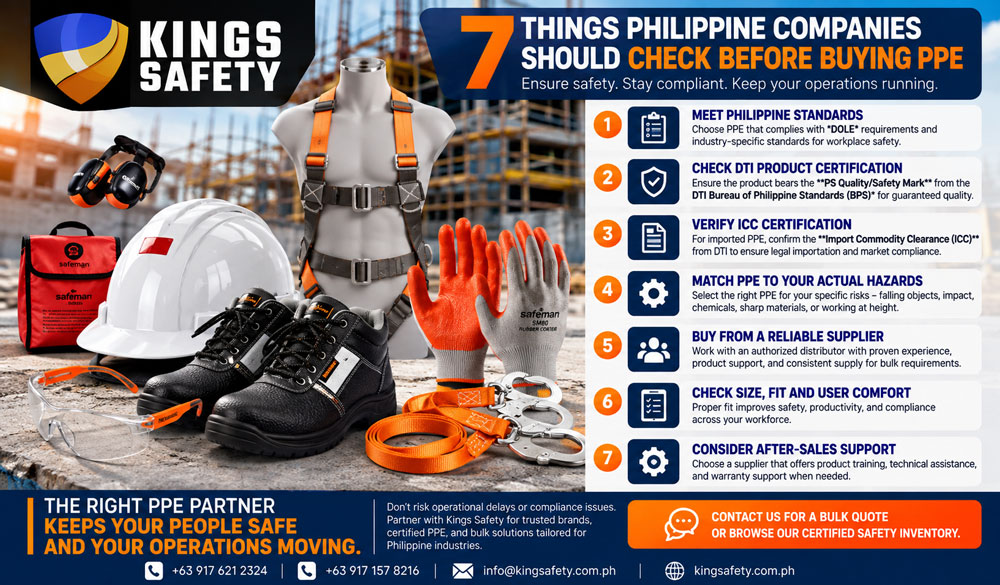
7 Things to Look for in an Industrial Safety Equipment Supplier in the Philippines
Not all suppliers offer the same level of product range, service, or support. Before choosing a supplier, consider these seven factors.
1. A Product Range That Matches Your Industry
A strong industrial safety equipment supplier should understand that different industries have different requirements.
Ask whether the supplier can support your specific applications, including construction, manufacturing, warehousing, engineering, maintenance, logistics, or other industrial operations.
A broader product range can also simplify procurement by allowing businesses to source multiple safety requirements from one supplier.
2. Quality and Appropriate Certifications
Do not evaluate safety equipment based on price alone.
Ask for product specifications and relevant supporting documentation. Where applicable, verify certifications and conformity information.
The Department of Trade and Industry’s Bureau of Philippine Standards operates product certification schemes involving the Philippine Standard (PS) Quality and/or Safety Certification Mark and Import Commodity Clearance (ICC).
For products covered by mandatory certification requirements, businesses should understand what markings and documentation should accompany the product.
3. Reliable Inventory and Availability
Imagine discovering that your business urgently needs hundreds of safety helmets, gloves, safety shoes, or protective vests but the supplier cannot fulfill the order.
Availability matters.
For companies with recurring PPE requirements, ask suppliers about stock levels, lead times, minimum order quantities, and their ability to support repeat orders.
4. Nationwide Delivery and Dependable Logistics
Businesses operating across the Philippines may require safety equipment delivered to different locations.
Ask potential suppliers whether they can reliably serve your operating areas and how they manage bulk or recurring deliveries.
For project-based businesses, dependable delivery can be particularly important because equipment delays may affect mobilization and project schedules.
5. Technical and Product Support
A good supplier should do more than send a price list.
Businesses may need help understanding product specifications, sizing, applications, compatibility, replacement requirements, and appropriate product alternatives.
This type of support can be especially valuable when purchasing specialized PPE or equipping a large workforce.
6. Competitive Total Cost; not Simply the Lowest Price
The cheapest product is not necessarily the most economical choice.
Consider durability, replacement frequency, worker comfort, product performance, availability, and maintenance requirements.
A product that costs slightly more but lasts longer and is better suited to the application may provide greater value over time.
7. Responsive Quotations and B2B Service
For businesses, responsiveness matters.
A capable supplier should be able to work with PPE lists, employee headcounts, project requirements, quantities, sizes, specifications, and recurring purchasing schedules.
Fast and accurate quotations can help procurement teams compare options and make decisions more efficiently.
How to Compare Industrial Safety Equipment Suppliers
Before making a purchase, create a simple supplier comparison checklist.
| Factor | What to Check |
| Product range | Does the supplier cover your safety requirements? |
| Quality | Are product specifications and relevant standards documented? |
| Availability | Are commonly required products available? |
| Pricing | Is the quotation competitive for your quantity? |
| Support | Can the supplier answer product and technical questions? |
| Delivery | Can the supplier reliably serve your locations? |
| B2B capability | Can they manage bulk and recurring orders? |
| Responsiveness | Can they provide timely quotations and assistance? |
This approach helps businesses compare suppliers based on overall value instead of choosing purely on price.
Questions to Ask Before Buying Industrial Safety Equipment
Before placing an order, ask:
Are these products appropriate for our workplace hazards?
What standards or specifications apply to these products?
Can you provide product specifications and supporting documentation?
Do you have the quantities and sizes we require?
Can you supply multiple locations in the Philippines?
Can you recommend suitable alternatives if an item is unavailable?
Can you provide a quotation based on our employee headcount or project requirements?
How should the equipment be maintained, inspected, or replaced?
These questions can help procurement teams make better-informed purchasing decisions.
Why PPE Should Be Part of a Larger Safety Strategy
Personal protective equipment is important, but it should not be viewed as the only solution to workplace hazards.
Effective occupational safety and health programs consider the hazards present in the workplace and prioritize appropriate controls. Depending on the situation, businesses may need engineering controls, administrative controls, safe work procedures, training, maintenance programs, and PPE.
PPE is often the worker’s last line of defense when hazards cannot be adequately eliminated or controlled through other measures.
This is why a good industrial safety equipment supplier should complement—not replace—the company’s broader occupational safety program.
How to Find the Right Industrial Safety Equipment Supplier in the Philippines
A practical purchasing process can make supplier selection easier:
- Identify workplace hazards.
Understand the risks associated with each task and work environment. - Determine the required PPE and safety equipment.
Develop a clear list based on workplace requirements. - Establish quantities and sizes.
Consider employee headcount, project duration, replacement requirements, and spare inventory. - Identify applicable specifications and standards.
Request appropriate documentation from potential suppliers. - Shortlist qualified suppliers.
Compare product range, quality, availability, support, delivery, and pricing. - Request detailed quotations.
Provide suppliers with enough information to prepare an accurate quotation. - Compare total value.
Look beyond the initial purchase price. - Choose a supplier that can support you long term.
A reliable supplier can help simplify recurring PPE procurement and future requirements.
Frequently Asked Questions
What should I look for in an industrial safety equipment supplier in the Philippines?
Look for a supplier that offers appropriate products, reliable availability, relevant specifications and documentation, competitive pricing, dependable delivery, technical support, and responsive B2B service.
What types of industrial safety equipment are commonly used in the Philippines?
Common categories include safety helmets, safety glasses, goggles, face shields, gloves, safety shoes and boots, respiratory protection, hearing protection, fall-protection equipment, high-visibility clothing, protective workwear, first-aid supplies, and safety signage.
How do I know if safety equipment meets the required standards?
Ask the supplier for product specifications, applicable certifications, testing information, and supporting documentation. For products subject to Philippine mandatory certification requirements, businesses should also verify the appropriate PS mark or ICC sticker where applicable.
Can an industrial safety equipment supplier provide bulk orders?
Many B2B safety equipment suppliers support bulk purchasing. When requesting a quotation, provide the supplier with your required products, quantities, sizes, delivery locations, and project or recurring-order requirements.
How much does industrial safety equipment cost in the Philippines?
There is no single price for industrial safety equipment. Cost depends on the product type, specifications, brand, quality, quantity, application, and other purchasing requirements. For accurate pricing, businesses should request a quotation based on their specific needs.
Can a safety equipment supplier help determine which PPE my workers need?
A knowledgeable supplier can provide product information and help explain available options. However, PPE selection should be based on the actual workplace hazards and the organization’s occupational safety and health assessment and program.
Get the Right Industrial Safety Equipment for Your Business
Choosing the right industrial safety equipment supplier in the Philippines is about more than finding a low-cost source for PPE.
Businesses need products appropriate to their workplace hazards, dependable quality, reliable availability, responsive service, and a supplier capable of supporting their requirements as they grow.
Whether you are equipping a construction project, manufacturing facility, warehouse, engineering operation, or industrial workplace, start with a clear understanding of your safety requirements and then compare suppliers based on quality, suitability, documentation, service, delivery, and total value.
Looking for industrial safety equipment for your business? Contact a qualified supplier today and request a quotation based on your workplace requirements, product specifications, quantities, and delivery needs.