Finding the right industrial safety supplies near me is an important priority for companies that want to protect their workforce, maintain safe operations, and support a strong workplace safety program. For industrial businesses in the Philippines, choosing safety equipment involves more than finding a nearby supplier. Companies also need to consider workplace hazards, product suitability, worker comfort, quality, availability, and ongoing replacement requirements.
From safety helmets and protective eyewear to industrial gloves, safety footwear, fall protection equipment, and protective clothing, the right personal protective equipment (PPE) can help provide an important layer of protection when workplace hazards cannot be completely eliminated or controlled through other measures.
For purchasing managers, safety officers, operations managers, contractors, and business owners, knowing what to look for when purchasing industrial safety supplies can make procurement more organized and effective.
This guide explains what Philippine industrial companies should consider when choosing industrial safety supplies, how to match PPE with workplace hazards, and what to look for in a reliable safety equipment supplier.
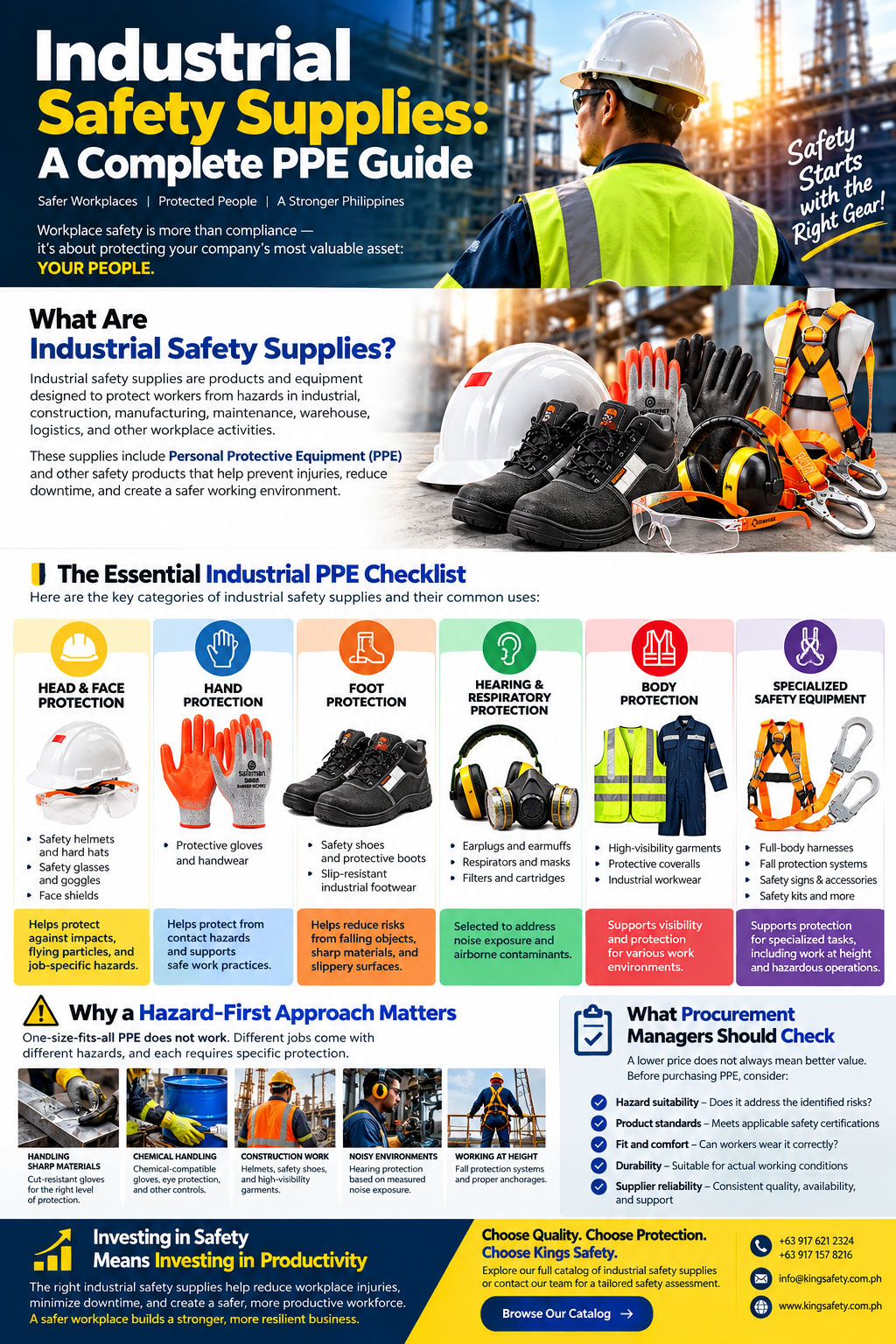
What Are Industrial Safety Supplies?
Industrial safety supplies are products and equipment designed to help protect workers from hazards associated with industrial, construction, manufacturing, maintenance, warehouse, logistics, and other workplace activities.
Depending on the working environment, industrial safety supplies may include:
- Safety helmets and head protection
- Safety glasses and goggles
- Face shields
- Protective gloves
- Safety shoes and protective footwear
- Hearing protection
- Respiratory protection
- Protective clothing
- High-visibility garments
- Fall protection equipment
- Body protection equipment
- Workplace safety accessories and related equipment
Personal protective equipment is generally selected according to the hazards workers may encounter during their jobs. A worker handling sharp materials, for example, may have different protection requirements from someone working with chemicals, operating machinery, performing maintenance, or working at height.
This is why buying PPE should begin with understanding the work and the hazards involved.
Why Industrial Companies Need the Right Safety Supplies
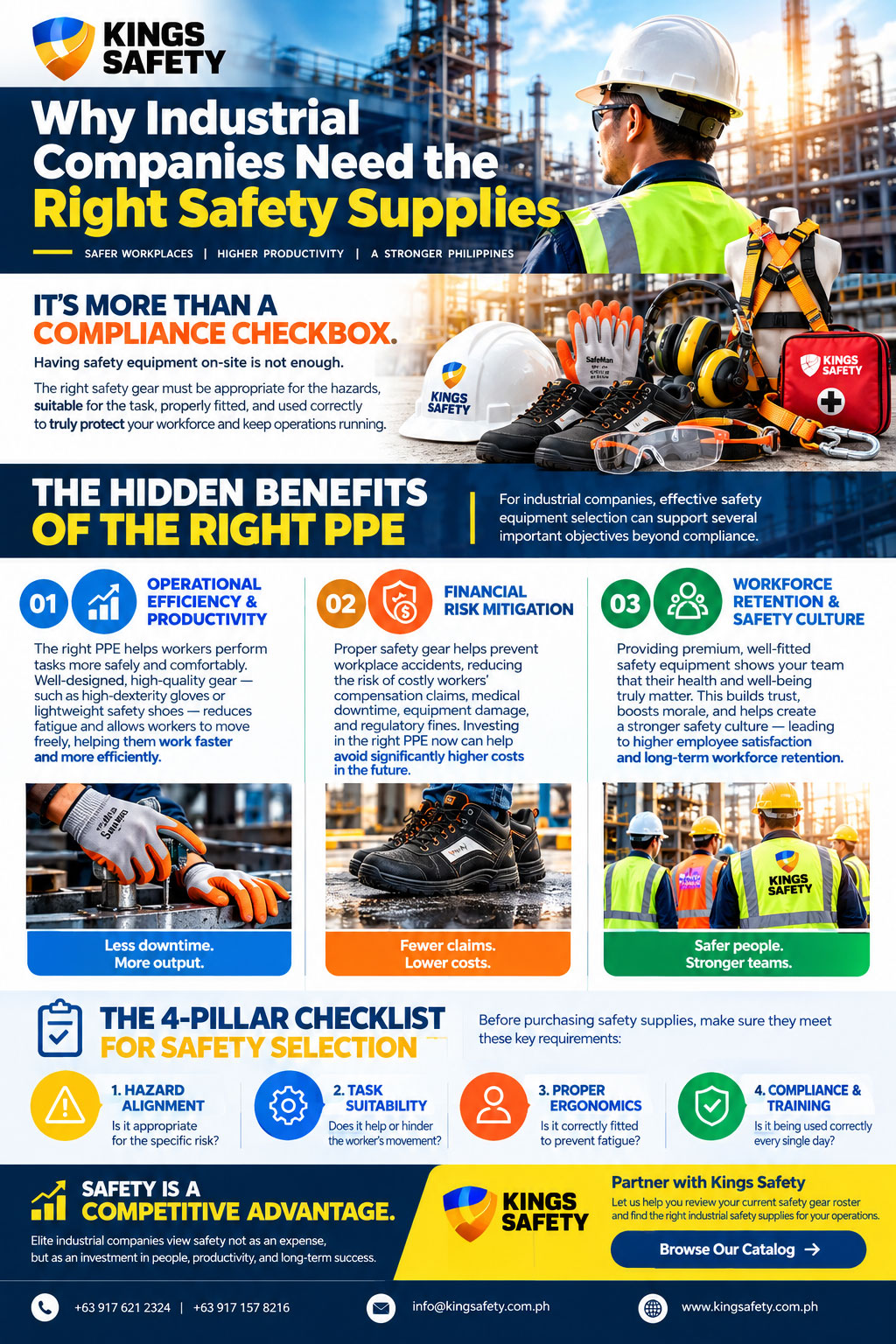
Workplace safety is not simply about having safety equipment available. The equipment needs to be appropriate for the hazards, suitable for the task, properly fitted, and used correctly.
For industrial companies, effective safety equipment selection can support several important objectives.
Protecting Workers From Workplace Hazards
Industrial workplaces can expose workers to mechanical, physical, chemical, electrical, noise, heat, falling-object, and other hazards.
Appropriate PPE can provide a protective barrier between a worker and certain hazards when other controls do not provide sufficient protection.
Supporting Workplace Safety Programs
PPE is one part of a broader occupational safety and health program. Companies should consider hazard identification, risk assessment, engineering controls, administrative controls, safe work procedures, training, and PPE as components of an overall safety strategy.
PPE should not be viewed as a replacement for eliminating or controlling hazards wherever practical.
Maintaining Operational Readiness
Running out of essential safety equipment can create procurement problems, particularly when companies need replacements quickly.
Maintaining appropriate inventory levels can help businesses respond to routine replacement needs, workforce expansion, new projects, and unexpected equipment requirements.
Building a Strong Safety Culture
Workers are more likely to take workplace safety seriously when safety procedures, training, equipment, and management practices work together.
Providing suitable safety equipment is therefore not simply a purchasing decision. It can also form part of a company’s broader commitment to workplace safety.
PPE Requirements for Philippine Workplaces
Philippine companies should consider the country’s occupational safety and health requirements when developing workplace safety programs and selecting PPE.
The Philippine Occupational Safety and Health Center provides technical services related to workplace exposure assessment and PPE testing. Its guidance on PPE emphasizes that personal protective equipment should have an approved design and construction appropriate for the exposure and work being performed.
The Philippines also updated the implementing rules and regulations associated with Republic Act No. 11058 through Department Order No. 252-25. Companies should therefore make sure their workplace safety practices reflect the applicable and current requirements for their operations.
For businesses purchasing PPE, this means product selection should not be based solely on appearance or price. Companies should consider whether the equipment is appropriate for the specific hazards and work activities involved.
Common Industrial Safety Supplies Philippine Companies Need
Different workplaces require different combinations of protective equipment. The following categories are among the most common areas industrial companies should evaluate.
Safety Helmets and Head Protection
Safety helmets can help protect workers from certain head-impact and falling-object hazards.
They may be important in environments such as:
- Construction sites
- Manufacturing facilities
- Warehouses
- Maintenance areas
- Industrial plants
- Infrastructure projects
When selecting head protection, companies should consider the hazards present, the type of work being performed, fit, compatibility with other PPE, and applicable product requirements.
A helmet that is appropriate for one work environment may not automatically be appropriate for another.
Safety Glasses and Face Protection
The eyes and face can be exposed to flying particles, dust, splashes, sparks, and other workplace hazards.
Depending on the task, workers may require:
- Safety glasses
- Chemical splash goggles
- Face shields
- Specialized eye protection
Grinding, cutting, chemical handling, machining, and other industrial processes may have different eye and face protection requirements.
Proper selection is particularly important because inadequate or incompatible eye protection can leave workers exposed even when PPE is being worn.
Industrial Safety Gloves
Hand protection is one of the most important PPE categories for many industrial workplaces.
However, there is no single glove that provides the best protection for every job.
Companies may need different gloves for:
- General material handling
- Cut hazards
- Abrasion
- Chemical exposure
- Heat
- Mechanical work
- Specialized industrial applications
When selecting gloves, businesses should identify the specific hazard first and then select protection appropriate to that hazard.
Comfort and dexterity also matter. Gloves that interfere significantly with a worker’s ability to perform a task may create additional operational challenges.
Safety Shoes and Protective Footwear
Industrial workers may encounter hazards involving falling objects, heavy materials, sharp objects, slippery surfaces, electrical risks, or other workplace conditions.
Depending on the application, protective footwear may incorporate different protective characteristics.
Businesses should evaluate:
- Workplace hazards
- Required protection
- Slip resistance
- Fit and comfort
- Working environment
- Compatibility with job requirements
The right safety footwear should allow workers to perform their duties while providing protection appropriate to the identified hazards.
Respiratory Protection
Some industrial environments may involve airborne contaminants, dust, fumes, vapors, or other respiratory hazards.
Respiratory protection requires particularly careful selection because different hazards require different types of protection.
Companies should not simply purchase a respirator based on general appearance. Respiratory hazards should be assessed, and appropriate equipment, procedures, training, and fit considerations should be addressed as applicable.
Hearing Protection
Industrial machinery, manufacturing processes, construction activities, and other operations can expose workers to high noise levels.
Common hearing protection products include:
- Earplugs
- Earmuffs
- Other appropriate hearing protection systems
The selection should reflect the workplace noise conditions and the requirements of the job.
Fall Protection
Workers performing tasks at height may require specialized fall protection equipment.
Depending on the work environment and applicable requirements, fall protection systems can include:
- Full-body harnesses
- Lanyards
- Lifelines
- Connectors
- Other fall-arrest or fall-protection components
Fall protection requires more than simply purchasing a harness. Workers need appropriate equipment, proper inspection, training, and procedures suited to the work being performed.
How to Choose the Right Industrial Safety Supplies Near You
Searching for industrial safety supplies near me is a useful starting point, but proximity should not be the only purchasing consideration.
Use the following process when evaluating PPE for your business.
1. Identify the Workplace Hazards
Start by identifying the hazards associated with each work area and job.
Consider hazards involving:
- Machinery
- Moving equipment
- Chemicals
- Electricity
- Dust
- Noise
- Heat
- Sharp materials
- Falling objects
- Slips and falls
- Work at height
- Material handling
Different employees may face different hazards even within the same facility.
2. Match PPE to the Specific Job
Once hazards are identified, determine what type of protection is appropriate.
For example, a warehouse worker handling general materials may have different PPE requirements from a maintenance technician working with machinery.
Avoid choosing PPE simply because it is popular or inexpensive. The equipment needs to correspond to the actual exposure and work activity.
3. Check Product Specifications and Standards
Before purchasing industrial PPE, businesses should review available product specifications and relevant compliance information.
Depending on the product category, this may include information relating to:
- Protective performance
- Product classification
- Intended application
- Materials
- Size
- Testing
- Applicable standards
- Manufacturer information
A reliable supplier should be able to provide useful product information to help business buyers make informed purchasing decisions.
4. Make Sure PPE Fits Workers Properly
PPE needs to be wearable and suitable for the person using it.
Incorrect sizing can affect comfort, usability, and protection.
For companies with large workforces, purchasing teams may need to account for different sizes and worker requirements rather than ordering a single size for everyone.
Compatibility is also important. For example, different pieces of PPE may need to be worn together without interfering with one another.
5. Consider Availability and Reordering
This is where the “near me” aspect of industrial safety supply searches becomes particularly relevant.
Industrial businesses often need safety equipment repeatedly rather than as a one-time purchase.
Local availability can be valuable when a company needs:
- Replacement PPE
- Additional employee equipment
- Bulk orders
- Project-specific supplies
- Emergency replacements
- Regular inventory replenishment
A supplier that can support ongoing procurement needs may be more useful than one that only provides a single transaction.
6. Evaluate the Supplier
The supplier is an important part of the purchasing decision.
Businesses should consider:
- Product range
- Availability
- Product information
- Responsiveness
- Business support
- Ability to handle recurring orders
- Bulk purchasing capability
- Product documentation
- Knowledge of industrial applications
The goal is to establish a procurement relationship that supports the company’s safety requirements over time.
Why Buying Industrial Safety Supplies Locally Can Benefit Philippine Businesses
For Philippine industrial companies, working with a local safety supplier can offer practical procurement advantages.
Communication can be easier when businesses need to discuss product specifications, quantities, sizing, availability, or replacement requirements.
Local purchasing may also make it more convenient to coordinate recurring orders and respond to changing workforce or project requirements.
However, businesses should avoid choosing a supplier solely because it is geographically close.
The most important question is:
Can the supplier provide appropriate safety products for the hazards and requirements of your workplace?
A nearby supplier with unsuitable products may not solve the company’s procurement problem. Conversely, a supplier that understands industrial requirements and can consistently provide suitable equipment can become a valuable part of a company’s safety supply chain.
Industrial Safety Supplies for Different Types of Workplaces
PPE requirements vary significantly according to the industry and work environment.
Manufacturing Facilities
Manufacturing operations may involve machinery, moving parts, sharp materials, noise, dust, chemicals, heat, and other hazards.
Depending on the process, workers may require combinations of eye protection, hearing protection, gloves, safety footwear, head protection, protective clothing, and other PPE.
Construction Sites
Construction environments can involve multiple changing hazards.
Workers may encounter falling objects, work-at-height hazards, machinery, tools, dust, noise, electrical hazards, and moving equipment.
Construction PPE selection should reflect the specific activities being performed at the site.
Warehouses and Logistics Operations
Warehouse employees may handle boxes, pallets, equipment, vehicles, and other materials.
Potential safety equipment may include safety footwear, gloves, visibility garments, head protection, and eye protection depending on the work environment.
Maintenance and Mechanical Operations
Maintenance personnel can encounter machinery, electrical systems, lubricants, chemicals, sharp components, heat, and other hazards.
PPE should be selected according to the equipment, materials, maintenance procedures, and work conditions involved.
Electrical Work
Electrical activities can present specialized hazards requiring carefully selected protective equipment.
Companies should ensure that PPE is appropriate for the electrical hazard and that workers receive the necessary training and follow applicable safety procedures.
Chemical and Industrial Processing
Chemical-handling environments require careful consideration of exposure routes and chemical compatibility.
Protective gloves, eye protection, face protection, protective clothing, footwear, and respiratory protection may be relevant depending on the specific substances and processes involved.
How to Build an Industrial PPE Purchasing Checklist
A purchasing checklist can make industrial safety procurement more consistent.
Before placing an order, consider the following:
Workforce
- How many employees require PPE?
- What are their job roles?
- What sizes are needed?
Hazards
- What hazards are present?
- Which workers are exposed?
- Are the hazards routine or task-specific?
PPE
- What type of protection is required?
- Are multiple PPE categories necessary?
- Is the equipment compatible with other required PPE?
Product information
- What are the product specifications?
- What is the intended application?
- What testing or compliance information is available?
Inventory
- How much PPE is currently available?
- How frequently is it replaced?
- What quantity should be maintained as backup stock?
Training
- Do workers understand when and how the PPE should be used?
- Do they know its limitations?
- Are inspection, cleaning, maintenance, and replacement procedures established where applicable?
This approach helps turn PPE purchasing from an occasional emergency purchase into a more organized procurement process.
Where to Find Industrial Safety Supplies Near Me in the Philippines
When an industrial company searches for industrial safety supplies near me, the goal should be to find a supplier capable of supporting the company’s actual workplace requirements.
A business buyer should look for a supplier that offers appropriate PPE categories, clear product information, dependable availability, and support for ongoing industrial purchasing needs.
For companies looking specifically for industrial body protection supplies, reviewing available body-protection products can be a useful starting point when building or updating a workplace PPE program.
If your company is sourcing safety equipment for employees, a practical next step is to identify the hazards associated with each role and then discuss the required PPE categories with a qualified safety equipment supplier.
For larger organizations, it can also be useful to provide the supplier with information about:
- Number of workers
- Job roles
- Required PPE categories
- Sizes
- Estimated monthly or quarterly requirements
- Current products being used
- Replacement frequency
- Project requirements
Providing this information can make it easier to identify appropriate products and develop a more efficient procurement process.
Questions to Ask an Industrial Safety Supplies Supplier
Before purchasing, industrial companies can ask:
Is this PPE appropriate for our specific workplace hazard?
The supplier should be able to provide product information relevant to the intended application.
What sizes and specifications are available?
This is especially important for companies purchasing PPE for multiple employees.
Is the product currently available?
Availability matters when companies have immediate replacement or project requirements.
What product documentation is available?
Businesses should review relevant product information before making purchasing decisions.
Can you support bulk or recurring orders?
This can be important for companies with large workforces or regular PPE replacement requirements.
How should the PPE be inspected and maintained?
Some PPE requires regular inspection, cleaning, maintenance, or replacement.
Can you help us identify appropriate products for different worker roles?
A supplier that understands the differences between applications can make procurement more efficient.
Frequently Asked Questions About Industrial Safety Supplies Near Me
What are industrial safety supplies?
Industrial safety supplies are equipment and products used to help protect workers from workplace hazards. They can include safety helmets, gloves, safety glasses, protective footwear, hearing protection, respiratory protection, fall protection equipment, protective clothing, and other safety products.
Where can I find industrial safety supplies near me in the Philippines?
Philippine industrial companies can look for local safety equipment suppliers that offer the PPE categories appropriate for their workplace. When comparing suppliers, consider product suitability, availability, specifications, business support, and the supplier’s ability to handle ongoing requirements.
What PPE does an industrial company need?
The appropriate PPE depends on the hazards and tasks present in the workplace. Common categories include head, eye, and face; hand, foot, hearing, respiratory, body, and fall protection.
Is PPE required in Philippine workplaces?
PPE requirements depend on the hazards and applicable occupational safety and health requirements. Philippine companies should assess workplace risks and follow applicable OSH requirements when determining necessary protective equipment.
How do I choose the right PPE for my workers?
Start by identifying workplace hazards and matching the PPE to the specific exposure and task. Also consider proper fit, compatibility, product specifications, worker training, maintenance, and replacement requirements.
What should I check before buying industrial PPE?
Check the product’s intended application, specifications, protective characteristics, sizing, available documentation, and suitability for the identified workplace hazard. Businesses should also consider supplier reliability and product availability.
How often should industrial safety equipment be replaced?
There is no single replacement schedule that applies to every type of PPE. Replacement depends on the product, manufacturer guidance, condition, frequency of use, exposure, damage, contamination, and applicable workplace procedures.
Can businesses buy industrial safety supplies in bulk?
Yes. Many industrial companies purchase PPE in larger quantities to support their workforce, projects, and recurring replacement needs. Businesses should discuss quantities, sizes, product specifications, and expected purchasing frequency with their supplier.
What is the difference between PPE and general industrial safety equipment?
PPE is equipment worn or used by an individual worker to reduce exposure to specific hazards. General safety equipment can include broader workplace controls, systems, signs, barriers, and other measures that help manage workplace risks.
Why should companies work with a reliable PPE supplier?
A dependable supplier can make it easier for businesses to source appropriate products, obtain product information, manage recurring requirements, and maintain adequate safety equipment inventory.
Conclusion: Choosing the Right Industrial Safety Supplies Near You
Finding industrial safety supplies near me should be about more than finding the closest available supplier. For Philippine industrial companies, effective PPE procurement starts with understanding workplace hazards and matching workers with appropriate protective equipment.
Safety helmets, protective eyewear, industrial gloves, safety footwear, hearing protection, respiratory protection, fall protection, and body protection all serve different purposes. The correct choice depends on the job, the hazard, the working environment, and the requirements of the workplace.
Businesses should also consider product specifications, fit, worker usability, availability, inventory requirements, training, maintenance, and supplier support.
For companies looking for industrial safety supplies in the Philippines, taking a structured approach to PPE procurement can make it easier to support workplace safety while keeping essential equipment available when workers need it.
If your company is reviewing its PPE requirements, start by identifying the hazards, determining the protection needed for each worker role, and speaking with a reliable industrial safety supplier about the products and quantities required.